28th October 2025 Remembrance
Each year, the Club holds a Remembrance-themed meeting and this time Hilary gave a fascinating and poignant talk, richly illustrated with family photographs, artefacts, and documents, about her grandfather’s life and his death on the Western Front shortly before the end of the First World War.
Alexander Callander hailed from Scotland and fell in love at first sight with Hilary’s grandmother, when in connection with his employment as a travelling draper, he met her working in a high class tailor’s on White Rock in 1909. They married the following year in Hastings, and opened a draper’s shop in Hendon, but her grandmother and the by then two daughters returned at the outbreak of war in 1914 to live with her parents in the house in which she had been brought up in Mount Pleasant Road in Hastings.
Alexander joined the King’s Own Borderers, but was hospitalised in Malta having broken a leg in two places; the letter home about this reveals he had changed regiments to the Leinsters. He expected to be repatriated, but recovered and, in the event, never returned home to Hastings on any kind of leave. The troop movements involved would point to the murderous campaign at Gallipoli, but it is uncertain whether he did actually get there.
By 1918, Alexander had joined his fourth regiment, the Lancashire Fusiliers. Although negotiations had already started to end the war, the British Fourth Army continued its advance towards the German lines in Picardy in northern France in early October 2018. Alexander was shot dead by a German sniper in the village of Joncourt on 2 October 1918. At first, his family thought he would return from the war, but eventually a telegram arrived in Mount Pleasant Road, confirming his death. Hilary’s mother, who was only seven at the time and lived into her nineties, never forgot that day. Her mother (Hilary’s grandmother) spent the whole day making and remaking all the beds in the house. Eventually, the family received a letter from the British Red Cross with details of where Alexander was buried.
After the war, Alexander’s Scottish family would invite their English relatives to visit their dairy farm in the south-west of Scotland every summer. One of their shire horses named Haig, who had been enlisted to pull big guns in France, remarkably survived the war and returned, but was too shell-shocked to work again and lived out his days quietly in the corner of a field.
While neither Hilary’s grandmother nor her mother ever expressed a wish to visit Alexander’s grave, Hilary and her sister visited the village of Joncourt on spec in October 2018 to take part in events to commemorate the centenary of the battle. They received a wonderful reception from the villagers and were taken to visit the graves of Alexander and around 70 of his comrades-in-arms. The descendants of the owners of the farm where these deaths took place still maintain the cemetery on behalf of the Commonwealth War Graves Commission. Amongst the memorabilia Hilary showed us was a medal marking the liberation of Joncourt. The commemoration events were held jointly with the nearby village of Ors. The world-famous war poet, Wilfred Owen, was the commanding officer of Alexander’s regiment and fell at Ors on 4 November 1918, exactly one week before the signing of the Armistice.
14 October 2025 Séjour à New York
At the Anglo-French meeting today, we were entertained by our very own talented, Roselyn, who talked about “Un Séjour à New York” when she and her husband went to live and work there. In her own captivating way, she described daily life in NY “et les petites choses de tous les jours.” We heard about being warned not to set a direct debit card: the client is always wrong! Getting registered with a doctor proved to be a game of round and round in circles. Three possible solutions: 1.Don’t get ill, 2. Attend the walk-in centre 3. Telephone the local Physician Assistant for a home visit. Not bad! They made their home in a luxury apartment on the 8th floor with stunning views, doormen and porters in livery and flowers in the foyer. In case we turned green with envy, it came with the warning, this is not real, it’s La La Land. We heard that “walking chickens” walk freely and that “Frankenchicken” are genetically grown whereas “smoked pigs tails” are just that. Most importantly, how do you find a good hairdresser? Well of course by asking a stylish woman in the street: where do you get your hair done? A number of unique ways of doing things, fairy lights purchased at the pharmacy, dogs “containerised” in handbags, mums with buggies plus skates and a screaming child apparently expressing herself!
Such a fun afternoon and all that spoken in excellent French!
13 May 2025:
At our most recent meeting we heard about the fascinating (and all too short) life of Jacques Brel, a Belgian singer, composer, actor and film director.
Born in Brussels in 1929, he first performed in the various cafés in his home town in 1952, signing his first recording contract with a publisher in Paris the following year.
Whilst his initial foray into the music world in the French capital was met with some harsh criticism, he persevered, eventually reaching number 3 in the national hit parade in 1956 with the song ‘Quand on n’a que l’amour’ (If we only have love). By 1959 he often abandoned his guitar and used a backing group to enable him to express the emotion in his songs more freely.
His collaboration with other musicians, who each contributed their own skills set to Brel’s music, enabled Jacques to focus totally on the words of his songs. By 1967, and at the age of just 37, he had achieved considerable success and recognition, and decided on a change of career which took him into musical theatre.
Whilst on tour in New York he had seen the musical ‘Man of La Mancha’ and recognised something of himself in Cervantes’ main character, Don Quixote. After buying the rights to write and produce a French version, which enabled him to play the parts of both Don and Cervantes, ‘L’homme de La Mancha’ was first performed in Brussels before moving to Paris to great acclaim, with even Belgian royalty attending a performance. His move into the film world was equal successful, both as an actor and later as a director, with his feature film ‘Le Far West’ being shown at the 1973 Cannes Film Festival.
His success brought him financial freedom, enabling him to indulge in two rather expensive hobbies: sailing and flying and, over time, he learned how to navigate on the high seas as well as gain his pilot’s license. In 1973 he moved to French Polynesia in the middle of the Pacific, planning to build a new life there with one of his girlfriends (although he was still married to Miche with whom he had three daughters).
In 1974 he was diagnosed with lung cancer, but, despite treatment, died at the age of 49. In the intervening period he continued to write; he joked about his illness, even looking under a piano on one notable occasion and asking if anyone had seen a lung.
His musical legacy lives on with many of his songs being translated into other languages and performed by artists such as the late David Bowie. A statue of Brel was unveiled in Brussels in 2017 and there is even a metro station named after him in his birthplace.
22 April 2025:
Our most recent meeting took us back to 17th century France and the famous writer of fables, Jean de la Fontaine. Whilst La Fontaine recognised the works of other writers such as Aesop, Phedre and Aristotle, his intention was to write short stories which caught the attention of his readers, but also to provide a universal morality. Growing up in the countryside and being close to nature, he used animals as the basis of his stories – highlighting the failings of humans, such as arrogance, hypocrisy, dishonesty and the absolute power of the king.
With the background of La Fontaine’s storytelling, several club members took part in presenting three of his well-known fables: ‘The Hare and the Tortoise’ (Le lievre et la Tortue), ‘The Crow and the Fox’ (Le Corbeau et le Renard) and ‘The Grasshopper and the Ant’ (Le Cigale et la Fourmis). In bringing the stories to life in an amusing way, we were able to consider whether we could find the answer to what the true purpose of literature is.
We also learned that La Fontaine’s birthplace was Chateau-Thierry, a short distance to the east of Paris and situated in the country’s champagne making region. Thus, a short visit to the Jean de la Fontaine museum, combined with a little wine-tasting would never go amiss! Below a link to further information:
8 April 2025:
At last week’s meeting one of our members, André, shared the fascinating story of his grandfather, Henry, as well as his father, Marcel and the family’s many years spent in France.
Following the end of the First World War Henry, a gardener, worked for the International War Graves Commission, and was stationed in Aubers, Northern France to tend the war graves there. Marcel was born in 1929 in Fournes, and, as a result of emergency surgery, was named after the doctor who saved him. Growing up as a foreigner in another country, Marcel had occasional problems integrating with the locals – at school a particular teacher disliked the English, so that each morning he had to sing La Marseillaise with the other children. One of the children’s pastimes was to go through the nearby fields to collect relics from the First World War, including helmets, shells, gun and rifle parts and then set fire to them. When, in 1940, the area was invaded by the Nazis, Henry looked to return to England with his family in the very last hand-made Peugeot ever made, which he had previously bought. Whilst the journey was not without its challenges and changes of destination from Dunkerque to Boulogne, the family was finally able to cross the Channel safely on board a Red Cross hospital ship and return to Hastings. Several years later, André came across a sign indicating Aubers was now twinned with Wadhurst – records show that several local men had fought and died in the battle of Aubers. A recently published book entitled ‘The Caretakers: War Graves Gardeners and the Secret Battle to Rescue Allied Airmen in WW2’ by Caitlin G deAngelis includes some of Henry Hayler’s story; and a podcast entitled War Graves Gardeners includes an interview with Marcel Hayler from 2019 and can be heard on Spotify.
25 March 2025:
The title of our most recent presentation – the Cathars and the Albigensian Crusades, delivered by our chairman, Steve – may have seemed a rather unusual historical concept for many of us. However, Steve’s introduction as to how he first became interested in the subject – through a seemingly pointless school exercise, a dislike of a particular history teacher, misinformation regarding his possible Huguenot ancestors and Kate Mosse’s books entitled The Languedoc Trilogy was enough to stimulate his interest (and subsequently ours) into researching further into an important part of France’s history.
It was in the 12th century that the differences between the north and south of France became ever more apparent. The two areas disliked and distrusted each other, with the southerners speaking a language much closer to Catalan, and major differences in politics, land ownership and religious tolerance. The Cathars – whose name was derived from Greek and meant clean or pure – had existed since the 7th century, whose spiritual beliefs had slowly spread throughout Europe, and were based on the Gospels, rather than those of the Catholic Church. Thus, God was considered to be of pure spirit, Jesus was but an angel whose existence in the New Testament was figurative only, an individual’s soul migrated from one host to another, the killing and eating of animals was forbidden and sexual relations resulted in the introduction of a new soul into an evil world or, worse, immortalised the cycle of souls in evil bodies.
Following the assassination of his friend and ambassador, Pope Innocent III called for the Cathars to be eradicated, believing the threat of heresy had become too difficult to manage by peaceful means. The Crusade lasted 20 years, with Crusaders coming from Northern France as well as further afield, capturing key towns such as Béziers and Carcassonne, as well as Albi, Castelnaudary, Castres, Faneaux, Limoux, Lombers and Montréal. Simon de Montfort, a prominent French nobleman was subsequently granted control of much of the area.
The legacy of the crusade is considered to have been influential in the establishment of the Dominican Order as well as the Medieval Inquisition, an institution set up to combat heresy.
11 March 2025:
As a 14 year old, Stephen found himself captivated by a beautiful German chiming clock displayed in the window of a shop he passed daily on his way to school. Finally summoning up the courage to enter the premises and purchase this glorious item, he was cruelly rebuffed with a resounding “No!” by the shopkeeper who announced that he was too young and would brake it. Mum to the rescue. She not only reassured the owner that it would be well looked after, but knocked the £2.10s asking price down by 5 shillings!
So started a life-long love affair with clocks.
After training as a gemologist, Stephen worked in a shop off St Martin’s lane, in Covent Garden, which also sold classic jewellery, watches and clocks. Clients would bring items in for repair, which Stephen would facilitate by contacting the relevant skilled craftsmen. This plunged him into a Dickensian world of characters and London’s maze of streets and alleyways. The various workshops were often on the top floor of dilapidated buildings – in one case access continued via a ladder into the roof space! And he fondly remembers a cockney craftsman, named Tom, who always greeted him with a cheery “Hello Sunshine” when he entered his “explosion” of a junk shop. In contrast he then delivered the most enormous French clock to a regular gem buying client’s apartment in Soho. After labouring up several flights of stairs and seeing the most perfect sideboard on which to place it, he glanced around the room, took in the heady aroma of cinnamon, the deep red decor, a sumptious bed which seemed to take up the entire floor space, then noticed the even larger mirror on the ceiling above! Clearly one should never judge a book, or a client, by its covers …
There were some hairy moments too. On one trip to an expert, Stephen found his route barred by road closures. Diving down a series of passageways to emerge in St John’s Square, he found himself face to face with the Queen! Totally flustered, he made a cursory bow, then fled. He does remember that the Queen just beamed at him.
On another occasion, when in the shop, Stephen heard what he thought was a loud gunshot. “Was business so bad that his boss had decided to end it all?” No. But almost as bad. He had just dropped and broken the carriage clock a client was coming in to collect a few hours later. There followed a mad scramble to scavenge and harvest movements from other clocks in the shop to effect a seamless repair. And a happy non-the-wiser- client was retained.
With the shop on a busy route to Leicester Square station, the passers-by and potential clientele were eclectic. Rich and poor. Actors, politicians, civil servants and … “barrow boys”. The original Covent Garden at 9 Elms ran from 4am to midday, so at noon, the market traders treated themselves to a slap-up lunch at one of the many restaurants near the shop, if they’d had a good trading day. Or they treated themselves to an elegant timepiece. Stephen had to fine tune his sales skills to match the bartering techniques of the traders, who could not conceive of paying the asking price for anything. The trick of waving a fat, rolled up wad of notes under Stephen’s nose was, it must be said, a persuasive method, on occasion, to clinch the deal.
Stephen then regaled us with the story of the “Marie Antoinette” case watch, reputed to have been commissioned for her, by her lover, the Swedish count Axel von Fersen. It was a masterpiece, created by Breuget, and, with an unlimited budget, took 30 years to complete. It has 823 components, way in excess of the normal 30-40 in a timepiece, and contained every watch function known at that time, including automatic winding, thermometer, minute repeater, shock absorber, stop watch, perpetual calendar (including leap years) chronograph and many more. The watch is encased in gold, with a clear face showing off the complicated movement of the gears inside. Other expensive materials used were platinum, rubies and sapphires. Its estimated current value is $30 million and this treasure is currently on display at the London Science Museum until 21 April 2025.
25 February 2025:
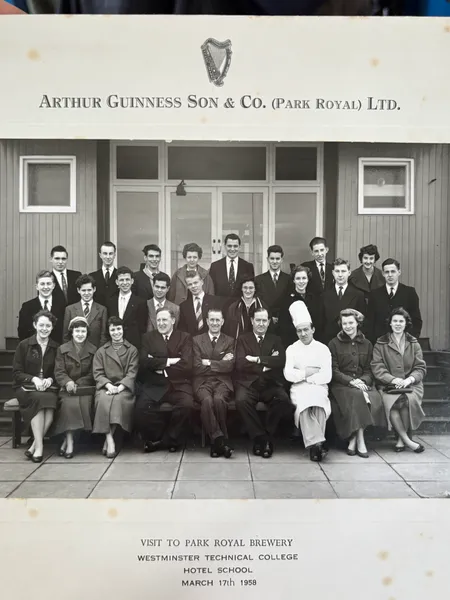
Our presentation last week was from one of our longest-standing members, Roger, who related his early life experiences in the hospitality industry. Inspired from living in his grandmother’s historic Lincolnshire guest house and recalling some of the county’s speciality dishes (including Pig’s Fry and Plum Bread), he enrolled at London’s famous Westminster Technical College in 1956. One of his first memories was of peeling carrots under the watchful eye of a French tutor – who promptly declared the result as awful and threw them all into the soup pot!
With several of the tutors speaking limited English and chatting to each other in French, it was a challenging time to learn the trade. Only later did it come to light that one of his tutors had been chef to the then Duke and Duchess of Edinburgh, later Queen Elizabeth and Prince Philip. A term spent at Kensington’s famous Hyde Park Hotel enabled Roger to see the trade in a different light – even though he was forbidden to earn any wages or accept a tip! Having successfully completed his college training, he was promptly conscripted to a 2-year stint in the Royal Air Force’s catering corps in 1960. Little wonder that he named his talk ‘In at the deep end’!
11 February 2025:
Our most recent meeting in St Valentine’s week included the theme of love throughout!
Starting with the story of the famous French biscuits known as ‘Le Petit Beurre’ with their 52 ‘teeth’ (representing the weeks of the year), the 4 ears (representing the 4 seasons) and the 24 holes (the hours in a day). It is the famous LU logo, which represents the love of the original biscuit maker, Jean-Romain Lefèvre for his wife Pauline-Isabelle Utile in the use of their initials.
The meeting went on to tell the story of how St Valentine’s Day may have come about over the centuries; the original Valentine is believed to have been based on two martyrs, each called Valentine, who were both executed on 14 February, but in different years, as punishment for performing marriages for Roman soldiers in secret, something which was forbidden by Emperor Roman Claudius II. In order to honour their deaths St Valentine’s Day was established.
In a very tongue-in-cheek play in Franglais, the members were entertained by a husband and wife discussing the sender of an anonymous card, signed with the letter R.
A quiz of French love sayings and a token chocolate love heart for everyone brought the meeting to a very enjoyable close.
28 January 2025:

La Fête GUILLAUME, in St Valéry-sur-Somme, twinned with Battle
At our most recent meeting we heard how the festival of Battle Bonfire (celebrated since 1646 and the oldest commemoration of the gunpowder plot in 1605) and la fête Guillaume in St Valéry-sur-Somme share an interesting historical link.
It was from this small French town in northern France that Guillaume (William) set sail for England with the aim of contesting the crown of England with Harold in September 1066.
Records show that William’s army defeated Harold at Senlac Hill in October 1066 and, in order to commemorate the 900th anniversary of this event in 1966, St Valéry approached Battle to create a link between the two towns. A monument was unveiled in St Valéry to recall William’s departure for England, with twinning documents being signed between Battle and St Valéry in July 1973.
In subsequent years there have been regular resident and student exchanges and visits to commemorate William’s historic departure and our own gunpowder plot – Battle having been given permission to build a gunpowder mill in 1676 on land owned by Battle Abbey. Both festivals include the wearing of historical costumes, as can be seen in the photos.
14 January 2025:
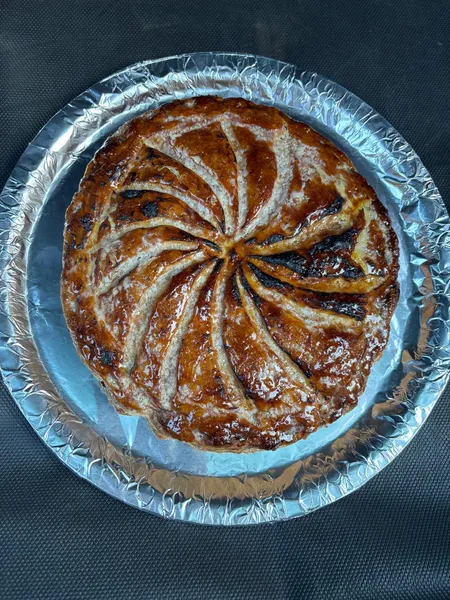
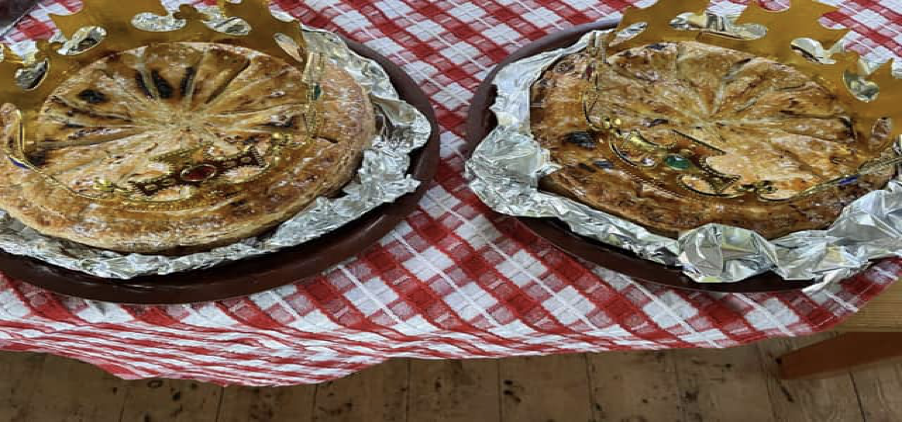
Our first meeting of 2025 celebrated ‘La Fête des Rois’, or the Feast of Kings (Epiphany), when a delicious large puff pastry cake filled with frangipane, apricot jam and a single charm is served (prepared by our own award-winning London chef). The person who finds the charm in their slice becomes king or queen for the day. The tradition dates back to pre-Christian times, when the cake was served at the end of a celebratory feast for servants and slaves, with one lucky individual wearing the regal crown for the day. A glass of French wine did, as usual, ease the digestion of the day’s delicacy. Another afternoon of fun and laughter was very much on the cards.
Our next meeting will be on Tuesday, 28 January, when we will hear about the fascinating link between Battle, its twin town of St Valéry-sur-Somme and two distinct annual festivals.
10 December 2024:
Our last meeting in December celebrated the festive season with a wonderful short play in ‘franglais’ where carol singers had learnt how to negotiate a doorstep donation, we racked our brains for answers to a Christmas quiz ‘à la française’, sang ‘une chanson de noël’, enjoyed some ‘vin épicé’ and French style goodies and, most importantly, welcomed once again one of our founder members, Josette.
Our first meeting of 2025 could not begin without the celebration of ‘la fete des rois’ – or Epiphany – with the traditional galette (prepared by our own award-winning London chef), a puff pastry cake filled with frangipane and a hidden charm to crown the king or queen. A glass of French wine will, as usual, ease the digestion of this delicacy. Another afternoon of fun and laughter is very much on the cards.
26 November 2024:
Our second November meeting focussed on someone else who made a difference in the 20th century, as well as the history of the Remembrance Poppy. Noor Inayat Khan, born in Moscow of Indian and American parentage came to England just before the 1st World War, moving to France in 1920, studying at the Sorbonne and later returning to the UK in 1940 following the German conquest of France. She joined the WAAF initially, later becoming part of the Special Operations Executive based in France and completing several dangerous missions, before being tragically betrayed, taken to Dachau and executed in 1944.
The history of our Remembrance Poppy links Canada, America, France and the UK, starting with the Lt Col John Maccrae’s poem ‘In Flanders Fields’, Moina Michael an American inspired by the poem soldiers, Anna Guerin, a French woman, known as the Poppy Lady and the British Legion.
12 November 2024:
In recognition of Remembrance Sunday this month, we heard the fascinating story of the ‘Ghost Army’, researched and delivered by another of our members, Roselyn.
This top secret mobile American Army – called the 23rd – was set up towards the latter end of WW2, with men who came from all walks of life and were to play a non-combat role in the battle against Hitler.
Their training was in the art of camouflage, deception and technology, supporting the Allies by giving the enemy the illusion of a huge 6th American army encampment, with inflatable tanks, repainted lorries, false radio messages, recordings of army sounds and songs.
The deception was to prove successful in Brest, the surrounding villages, in Metz as well as in Luxembourg – but the ultimate goal was to convince the Germans that two armies consisting of 30,000 soldiers were preparing to cross the river Rhine and the strongly defended German border from a location 10 miles away from where they actually were!
The ruse was hugely successful, with the Allies pushing on to Berlin, Hitler committing suicide, the Germans surrendering and the ‘Ghost Army’ able to return home.
It was only 50 years on that the declassification of the ‘Ghost Army’ papers allowed their story to be told and eventually for President Biden to award all of the 1100 23rd HQ men the Congressional Gold Medal in 2022.
Our next meeting is on Tuesday, November 26, when our presentation will be about Noor Inayat Khan, an Indian princess who served as a British resistance agent in France during WW2. We shall also be looking briefly at the history of the Remembrance Poppy.
22 October 2024:
At our most recent meeting we were taken on a Wine Walk deep in France’s south-west wine region of Tarn, called Gaillac.
With a wonderful selection of photographs Jill, one of our members, first described the area’s long viticultural history, before explaining how the worldwide charitable organisation – The Lions pub – took on the organisation of this important fund-raising event over a decade ago.
The walk takes place in June, is limited to just 1000 participants, who each pay 40 euros and who must book their place well in advance.
Each participant receives a small bag at the start containing essential its for the walk – a wine glass, cutlery, a list of the wines and food on offer at each of the five stops – and a straw hat.
With each of the stops in turn representing a different part of a meal – starters, cold meats, main course, cheese and dessert – and musical accompaniment in glorious French sunshine it was most definitely a great day out alongside much-needed funds being raised for the local hospital.
8 October 2024:
Our bilingual talk this week took us on the second part of our member’s journey to the Aude region, where in 2013 Peter and his wife purchased a run-down former presbytery in a tiny, circular hillside village near historic Carcassonne in the south-west of France. We heard the story of the ongoing renovations and improvements needed from ‘top to toe’ – including negotiations with the mayor to agree the approved colour for the property’s rendering – both to the property and its surrounding garden.
Whilst the area was historically famous for the manufacture of hats and formica (who knew?), its main industry is agriculture and, therefore, wine production thanks to its wonderful climate and terrain. The well-known and, allegedly, world’s oldest sparkling wine, Blanquette de Limoux, hails from the nearby town of the same name, being first produced in the 16th century by monks in a local Benedictine abbey. As a final treat we were also offered a taster of the region’s best known export. A votre santé!+
24 September 2024:
Last week’s meeting was a presentation entitled ‘words form the threads on which we string our experiences’, ably delivered by one of our recent new members. Andy Downing shared the story of the ups and downs of his life, from an extremely tongue-in-cheek perspective, starting as a ginger-haired lad born and living in Stoke-on-Trent, where much of what he experienced as a youngster was accepted without question, but in later life has grown bizarre. The story of his father, Bill, asking for a pay rise to equal his co-workers’ wages, being refused, then placing a pin in a map to move elsewhere in the UK, relocating to Sussex and finding work in the old Hastings Observer building for more than a decade, was one of the many anecdotes he shared. Speaking fluently in both French and English (thereby ensuring everyone understood his intriguing life story), Andy took us all through equal measures of laughter, intrigue and sadness. Hastings and beyond leave a lasting impression – the pin and the map have joined forces to form the basis of a lifetime of memories.
6 September 2024:
After our long summer break, during which we hope everyone has been able to enjoy the (occasional) sunny days, our club is preparing to meet again, and we very much hope to welcome back our previous members, as well as new members. We have been busy putting together the final touches to our September to December programme, topics to include ‘A wine walk’ and ‘The History of the Remembrance Day Poppy’; our first meeting will be on Tuesday, 10 September, starting as always, at 2.30pm. We look forward to catching up with everyone and hearing about their holidays and/or their staycation adventures, which will be the theme of our first meeting. We also welcome any relevant holiday snaps that members and visitors would like to share.
Our annual membership remains at £25 for our 17 meetings from September through to May; alternatively, should you prefer to attend on the odd occasion, the charge will be £3 per session attended. Either way, we hope you will agree that this is exceptional value for money. We meet every 2nd and 4th Tuesday of the month at the Holy Redeemer Church Hall, Upper Church Road, St Leonards. There is ample free parking nearby and there is also wheelchair access. More information on where to find us and our programme can be found on our facebook page, Hastings Anglo-French Club, or on our website www.hastingsanglofrenchclub.com.
28 May 2024:
Our final meeting of the 2023/2024 season took place last week and gave us the opportunity of reflecting on another successful year, following the trauma of Covid. The committee and members have worked hard together to provide varied and entertaining afternoons at our twice-monthly meetings, including personal life stories, popular French music from past decades (who remembers La Mer by Charles Trenet?), plays by famous French writers, illustrated talks about special areas and places of interest, Mardi Gras celebrations and much more besides – all linked with France and its language.
We shall be opening our doors once again on Tuesday, 10 September at 2.30pm at our usual venue in Holy Redeemer Church Hall, Upper Church Road, St Leonards TN37 7AS. We welcome all Francophiles and French speaking nationals. There is wheelchair access to the Hall and free parking nearby.
14 May 2024:
For our first meeting in May, we broke into small groups and were given short plays in French to read out loud to each other, with each member of the group taking a different role. Having checked any words or expressions that were unfamiliar, different groups then joined up in order to retell the stories in our own words. The plays were short, engaging and funny and it was a great exercise in reading, understanding and communicating in French, in an enjoyable and relaxed way.
Our next meeting on Tuesday 28th May is also our last for the season. After the AGM, we will have a chance to relax and socialise, chatting in either French or English over wine and nibbles.
23 April 2024:
Our second meeting in April provided us with an afternoon of wonderful musical nostalgia, listening to popular French songs from the 60’s. With hits from many of the well-known names of that decade, as well as a few less famous singers, together with song-sheets, we could follow the lyrics, join in, as well as practise our language skills. For most of us it was very much a trip down memory lane, recalling our lives all those decades ago.
Our next meeting is on Tuesday 14 May, when we shall be working in small groups and practising our language skills from a variety of prepared short plays in French. This has previously proven very popular, as members have the opportunity of speaking French in a safe environment, as well as having fun.
9 April 2024:
Last week’s meeting was a change to our published programme, when some of our members performed a highly entertaining extract from Molière’s comedy ‘Le médecin malgré lui’. This tells the story of Sganarelle, a poor woodcutter who spends his meagre earnings mainly on drink, and whose long-suffering wife, Martine, takes her revenge by telling others her husband is an eccentric, but brilliant, doctor who will only admit his identity after being severely beaten. When Sganarelle is asked to treat the apparently mute Lucinde, the plot ineveitably unfolds into a comedy of misunderstandings. With occasional explanations of the plot in both French and English, our members were easily able to follow the story of one of Moliere’s satirical plays.
For our next meeting on Tuesday 23 April we will be listening to some of France’s popular 60’s music, which will include many familiar and, perhaps, a few not so familiar songs and tunes from another era.
26 March 2024:
Last week’s meeting had us all sitting on the edge of our seats, as we heard about our member, Roselyn’s, ‘petites aventures en avion léger’(adventures in a light aircraft). From recalling how her husband’s hobby first started, her unexpected role as navigator (sometimes emergency responder), and their first tentative flights, to almost making a forced landing in the grounds of Blenheim Palace, it was a truly fascinating and entertaining presentation. With stories of further adventures around carefully selected areas in the UK, to crossing the Channel and visiting Northern France, Roselyn gave us a delightful insight into the joys, and sometimes perils, of this unusual hobby.
12 March 2024:
Last week’s meeting opened with a delightful rendition of Kenneth Williams’ ‘French’ version of Auld Lang Syne entitled ‘Ma Crepe Suzette’, performed by one of our members, with his guitar accompaniement. This was followed by a short playlet, spoken in franglais, set in a pharmacy, with the dialogue in a wonderful mix of French and English, causing hilarious misunderstandings and confusion.
Returning to our more usual meeting content we then broke up into small groups, sharing personal amusing anecdotes in French, from travel adventures to organising unexpected surprises for families or friends.
27 February 2024:
Our last meeting included a brief history of the provenance of language worldwide, with a fascinating explanation of the difference between ‘pidgin’ and creole. Our club member, Chris, went onto to talk (in French and English) about the many happy years she and her husband spent teaching English and Maths in New Guinea. She gave a fascinating insight into their experiences, with photographs of the island, the projects they were involved in and the friendships they made, some of which have lasted almost 50 years. She told us with great pride that many of her students have gone on to highly successful careers in law and politics.
Our next meeting is on Tuesday 12 March and will include a wide variety of the French language, including a short play, a very entertaining musical rendition, followed by the opportunity to practise speaking French in small groups.
14 February 2024:
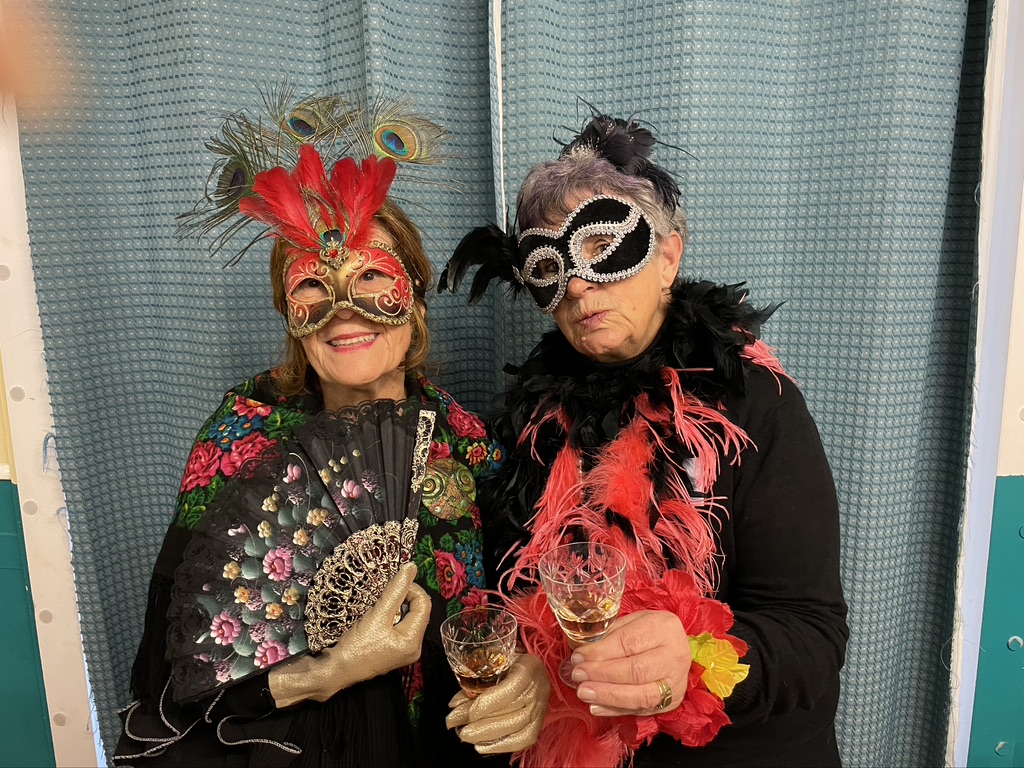
What a success our Mardi Gras meeting turned out to be, with so many members joining in the fun, wearing fancy dress in the form of masks, wigs, feather boas and much more besides. A very interesting talk by one of our members, explaining the origins of the tradition, with pictures of the fancy dress worn in different parts of France, as well as the variety of Mardi Gras celebrations throughout the country gave us a wonderful insight into French culture. Inevitably, our meeting also included some traditional sweetmeats dipped in marsala – it would have been rude not to!
Our next meeting is on Tuesday, 27 February, and will take us on a very different experience with an illustrated presentation by one of our members entitled ‘The amazing diversity of culture and languages in New Guinea’. This small island is the world’s most linguistically diverse region and has led to the rapid growth of one of the best known creole languages – Tok Pisin – a useful lingua franca, now recognised as one of the four official languages of Papua New Guinea.
23 January 2024:
Our last meeting gave us the opportunity to escape the gloomy winter days for a short time, as we enjoyed a wonderful illustrated talk on the ‘Treasures of the Loire’ by one of our members. In particular, the talk focused on some of the lesser well-known châteaux in the western Loire, including Angers, which had been the site of the Plantagenet rulers and the amazing collections of medieval tapisseries, as well as the more modern artworks by Jean Lurçat, called the ‘Song of the World’. Among the many and imposing renaissance châteaux built on the vestiges of medieval fortresses was the château of Valençay, former home of Prince Talleyrand, the minister of Foreign Affairs for Napoleon, and the gaoler of the Spanish Court. A wonderful overview of the château of Villandry’s unique gardens with its famous patterned borders, flowers and vegetables – all said to have been inspired by the philosopher and writer Jean-Jacques Rousseau – ended our virtual tour.
9 January 2024:
Our first meeting of 2024 was another celebration called ‘la fête des rois’ or Epiphany.
In France this involves everyone eating a slice of the delicious ‘galette’ – a traditional cake, celebrating the arrival of the Three Wise Men in Bethlehem and composed of puff pastry filled with frangipane and a charm or ‘fève’ hidden inside.
The person who finds the ‘fève’ is crowned, becoming king or queen. Whilst washing down our slices of galette with some French wine, we enjoyed a light-hearted quiz on all things French covering food, cooking, wine, the arts, literature and geography.
The club’s next meeting is on Tuesday 23 January, and our illustrated presentation is entitled ‘les trésors de la Loire’, when our speaker will be focussing on the beautiful châteaux and gardens of that lovely area of France.
A welcome escape from our gloomy winter!
 Hastings & District Anglo-French Club